Pages

2/26/2014

Mid-term critiques, done!

Saturday was a long day of mid-term critiques for our class of 2014. The presentations made for a late night on Friday and an anxious Saturday (I didn't present until 2.30pm), but it means we are one milestone closer to graduating! Hooray!

standing next to my presentation material
Listening to feedback post presentation, and smirking, apparently.

For my presentation, I built a phylogenetic tree of sorts representing the different pathways of access I am investigating. (See the matrix of prototypes, discussed in Thesis meetings: 2/14/14)The common ancestor is accessibility, and each of the explorations through which a visitor can interact with or learn about the work fits into one of the four broader categories -- material, visual, dimensional, and historical.

Overall my presentation and critique went well. Plenty to chew on and figure out before the next milestone in March...

2/19/2014

Thesis Meetings: 2/18/14

Most of this week's meeting with Scott was spent discussing my presentation for the critique this Saturday.

Here's a summary:

My shift in perspective is key.
The roots of my current investigation are in the way that people who are blind experience an art museum and how that experience could be improved. Originally, I wanted to create experiences through which people who were blind could access art from different pathways.

But, I realized that access is limited for a lot more people that I originally was considering. I shifted from designing something for a specific user group, to designing something for the general public. By representing works of art through different mediums, people can access them from new perspectives and are bound to see or learn something new.

2/12/2014

Thesis Meetings: 2/11/14

This week I got feedback on my second RP, for now called Pixeled. This prototype, like the previous one, changes vision from a comprehensive process to an additive process, and asks the question, what will we notice when we deliberately slow down our vision?

In Pixeled, the user starts out by choosing a piece of art to look at. An image of the selected work is projected, but it is a distorted version of the user's selected piece. As long as the user is willing to spend the time, the image will slowly reveal itself.

I used Processing for this prototype. After the sketch is opened and a set amount of time passes, a prompt pops up, and the user can "click to reveal," which will decrease the size of the pixels. The sketch is currently set so the user has to go through 12 levels of de-pixelation before they see the clear image, but this is fully adjustable so I can made adjustments as needed!

screenshot of the very pixelated image
Cézanne's Still Life with Apples distorted through 50x50 pixels
screenshot of the pixelated image
A few levels less distorted. The prompt "click to reveal" shows up after a set period of time.

Some clear shapes beginning to form

2/06/2014

Thesis meetings: 2/4/14

A good meeting with Scott this week and my first rapid prototype.

One of the ideas I have been discussing is the difference in the way you see something with touch (additive) and the way you see something with vision (comprehensive). So my first prototype was built to explore this idea: How can you make vision additive?

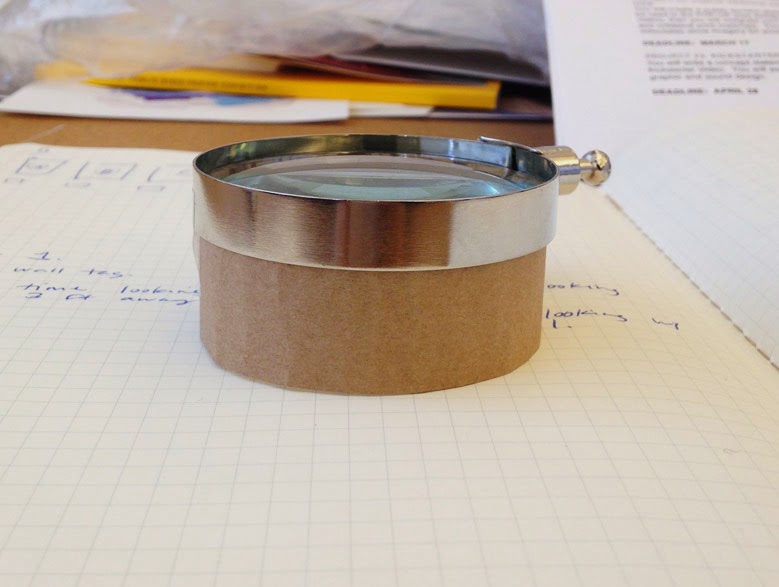
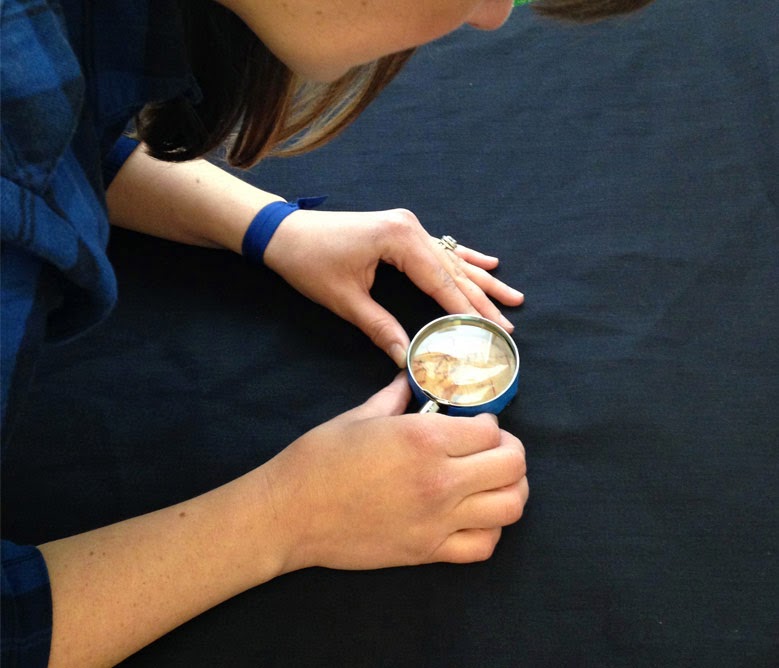
The user sees an image a little bit at a time by looking through a loop which is surrounded by cloth to obscure the rest of the image. The longer they spend, the more they learn about the image. I used a magnifying glass lens as a loop, and secured it into the center of a piece of black canvas which acted as the blind.

loop made of magnifying glass lens and cardboard
I attached a strip of cardboard to raise the lens and increase magnification

Homemade loop surrounded with canvas
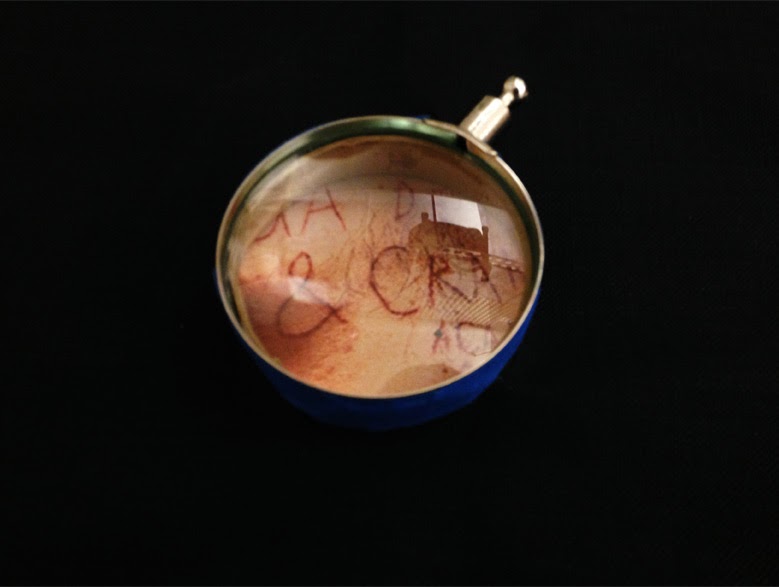
Looking through the lens at Poster for the Stefan Sagmeister AIGA Program in Detroit [Text scratched onto the nude body of the designer]


My hypothesis was that generally, people see things and move on. We don't really look close enough to notice the details. But when you have to discover an image bit by bit, you slow down and pay closer attention to details; you learn things you wouldn't learn by seeing the whole composition at once.

I gave participants four images to choose from: Paul Cezanne's Still Life with Apples, an image of Henry Weekes' Bust of Mary Seacole, Georges Seurat's Study for "La Grande Jatte," and Stefan Sagmeister's Poster for the Stefan Sagmeister AIGA Program in Detroit [Text scratched onto the nude body of the designer]. Once the participant selected an image, I placed it on a light table and covered it with the viewing/obscuring tool.

While this exercise was extremely literal, I think it was a good one to do. My classmates enjoyed the process of discovery and most of them pointed out how much they were drawn into the detail.

participant trying the prototype
Jess, exploring a print out of the Sagmeister poster

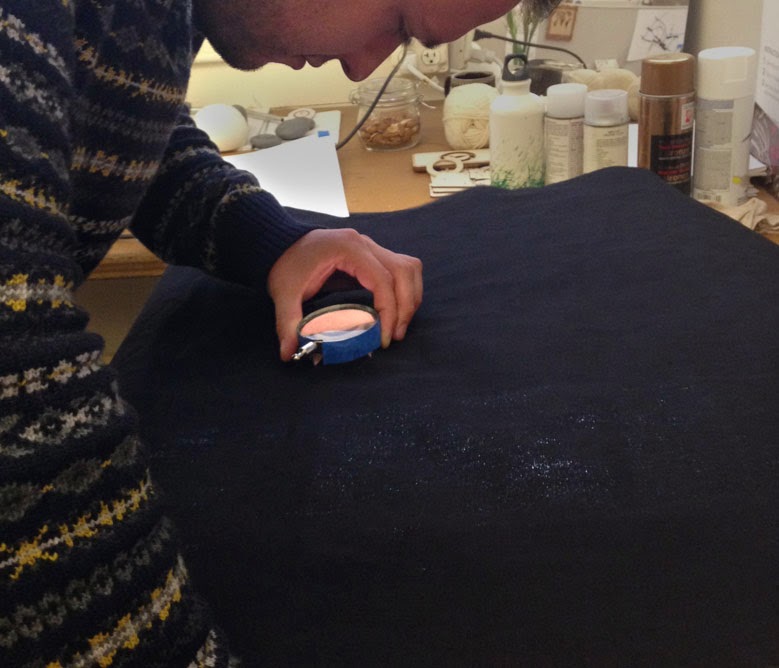
another participant trying the prototype
Agu, exploring Cezanne's Still Life with Apples. Some participants were chose pieces because they were familiar, some chose pieces because they were unfamiliar.

In attempt to keep myself and my thinking from jumping around like popcorn kernels in a microwave, I spent some time this week making a matrix of prototype ideas which includes description, hypothesis, materials, category, what I am measuring against, and the prototype's conceptual relevance to my project. I hope that by organizing these experiments into the various bodies of information I want to explore ("category," on the spreadsheet), I will be able to explore each body of information more completely.

1/30/2014

Thesis Meetings: 1/28/14

Last week resulted in a lot of reading and reading, and a bit more reading. With my new shift/focussing one of the big to-dos was to define new luminaries and get into the scholarship around multi-sensory exhibits.

As a result, I am adding these four to my list of luminaries.

Amanda Cachia: Curator from Sydney, Australia. Currently completing her PhD in Art History, Theory & Criticism at the UC San Diego. Former student at CCA.1
Madeline Schwartzman: Author of See Yourself Sensing, a survey of artists and designers who explore relationships of the body, technology, and senses.
Georgina Kleege: Teaches creative writing and disability studies at UC Berkeley.
Juhani Pallasmaa: Finnish architect. Author of The Eyes of the Skin – Architecture and the Senses.

Last week I also made my list of CCA faculty I would like to reach out to for a discussion about what they think as artists or curators. So far I have met with one curator, and will reach out to others today.

Here are my discussion questions:
  • What is the societal purpose of an art museum?
  • Are art museums accessible to the general public? Should they be more or less accessible?
  • What is the value of handling objects versus looking at objects?
  • As a curator, how do you decide which stories to tell?
  • As a historian, what do you do when you don't know the answer?
  • In terms of displaying work and telling object stories, what are museums doing right?
  • In terms of displaying work and telling object stories, where are museums falling short?
In terms of multi-sensory exhibits, there have been a number of them done and studies and luckily, the general feeling is that yes, they do indeed increase visitor enjoyment, retention, and understanding of the content of the exhibit. This was something that Scott and I spent a majority of our time discussing. If the multi-sensory museum exhibit is often done and accepted as  good, then why am I focusing on this? 

My work needs to be responding to something, or taking a stance; I need to define the motivation driving my experiments. 
Here is where my luminaries come in. In an article about her experience during a touch tour at MoMA, Georgina Kleege writes that vision is immediate and comprehensive, where as touch is additive and discovery happens a bit at a time.2 This same point also came up during a discussion with my classmate, Tim Carpenter, and this is one of my driving forces. What would happen if vision were not comprehensive and immediate? A new way of seeing could make you slow down, notice new details, and come up with new questions. How might I make an experience that invites users to view art in an additive way?

Kleege also makes a point that "since everyone does not get to touch the art, as much as they might want to, there is a value in hearing what we—the privileged few—have to say about it.”3 This also feels like potential to become a driving force but I need to think on it for longer.

What else are my driving forces? Scott and I discussed a few options which sounded like there was potential. What does it mean to really experience something from a historical perspective? What about material or process immersion?

What is the experience I want people to walk away with? 
So far my language has been about seeing objects anew, in stages or layers, and finding nuance. I don't want my experiences to feel forced or contrived. This experience, like all museum experiences, should to be enticing. I also don't want to overwhelm people with views. I want increase access by means of creative multi-sensory views, but Scott cautioned against offering so many views that the visitor feels there is nothing left to discover.

What happens when I inevitably cannot display a masterpiece in the design MFA exhibition?
1) Too early to worry about this.
2) There is also the philosophical case to be made that the masterpieces we see today aren't the "original" anyway. There are countless mediation factors; the obvious factors (lighting, glass, museum crowds, velvet ropes) and the less obvious factors (discoloration, canvas modification, restoration, curator and museum perspective, forgeries).

With this in mind, perhaps there really is no genuine experience, in which case it doesn't matter whether the "original" is present. It is a big, bold point to make, but I like it.

To do
Start a running list of all the multi-sensory art exhibitions and related studies
Look into the Pilara Foundation Collection at the photography museum at Pier 24 in relation to the no genuine experience concept.
Come up with +/- six  "driving forces"
Contact more curators and artists
Finish my work plan and keep working


1. Cachia, Amanda. “Talking Blind: Disability, Access, and the Discursive Turn.” Disability Studies Quarterly 33.3 (2013): n. pag. Web. 23 Jan. 2013.
2. Kleege, Georgina. "Some Touching Thoughts and Wishful Thinking" Disability Studies Quarterly 33.3 (2013): n. pag. Web. 6 Oct. 2013.
3. Ibid.

1/27/2014

Thesis meetings: 1/21/14

The new semester is here (gulp) along with a narrowing and slight shift in my thesis direction.

In the most concise explanation, I am exploring visual art beyond the visual.

Basically, I mean that I am looking at the meaning of accessibility in art museums and using tactile and multi-sensory experiments to amplify and expose non-visual information. I want to create probes that explore tangible elements such as scale, weight, materiality, and less tangible elements such as process, and context.

Here are the notes from my first meeting with adviser Scott Minneman.

I could make the case that a lot of visual art is "inaccessible." 
Art on a wall of a museum, perhaps, is just a statement. Contextualization and interpretation is very limited.
What about audio tours and docents? Those are great! But they take planning and/or extra money; docents aren't always available and both audio tour and docent tour usually cost extra. With most audio tours, there is little room for interpretation.

Your original thesis topic was to improve the museum experience for visitors who are blind. What happened?
What I learned from my conversations and museum experiences with people who are blind is still guiding my direction. However, I realized that I wanted to look at "accessibility" in a broader sense. Rather than make a tool for one user group, I want to make a tool that will increase accessibility for anyone who uses it. Museum visitors who are blind are still an important user group for me, but are no longer the only user group.

Are multi-sensory art exhibits too extreme/unrealistic/impractical?
Well, museum are already weird and extreme. For example, historical pieces that were never meant to be seen in white walled rooms are seen in white walled rooms. Museums could be thought of as a particular historical "accident."
In the words of Thomas Thwaites from The Toaster Project*, "there’s not much point in imagining futures that are the same as the present. For one, it’s not very interesting, but it’s also not very useful, and can be dangerous" (176).
So there.

When a piece is sold, the owner gets to touch it as much as s/he wants.
But in public institutions, obviously this can't be done.

What do artists think? What stories, if any, do they want told?
Also, what do curators and historians thing? What do they want told? A multi-sensory exhibit also opens the door for a multi-story exhibit. It will vary from person to person, but I need to get some data points in terms of what artists and historians think about multiple object perspectives.

To do
Come up with new luminaries
Read scholarship around multi-sensory exhibits
Contact curators and artists to learn about sacred cows
Look at the Gardener museum in Boston
Read up on current language of Universal Design
Watch Understanding Art: Hidden Lives of Masterpieces

To answer
What are my guiding principles?
How do I qualify successful experiments?
Who am I in service of?
Whose story am I telling and will it be historically accurate?
How do curators deal with unanswered questions?


* Based on Thwaites's MFA design thesis project, very, very, very inspired and inspiring.

11/03/2013

Explorations in Perception

I started reading See Yourself Sensing: Redefining Human Perception by Madeline Schwartzman, and boy, is it a trip. The book is a survey of projects and works that explore human perception, senses, and the body. The projects are visceral, often disturbing, provoking, and thoughtfully curated.


The cover image of See Yourself Sensing
Hyungkoo Lee, The Objectuals
Image of a person being shot with flames in Hobijn's self-immolation machine
Erik Hobijn and self-immolation
Image of Lawrence Malstaf suspended and shrink wrapped in a sheet of plastic
Lawrence Malstaf, Shrink