Pages

Showing posts with label design writing. Show all posts

7/16/2013

Object of the Day

Object of the Day is a daily blog by the Cooper-Hewitt National Design Museum aimed to help you discover a different object from the collection every day.

I did a post as part of my summer internship, which you can see on the website here, or read below.

Collection Connections


As a new member of the Digital + Emerging Media team here at the Cooper-Hewitt, I've been spending a lot of time learning about our various projects in process. One of the most enthralling resources I've encountered so far is the collections database. Try it out, if you haven't already; you'll see why it's so satisfying to explore. Here's an example. I started browsing with the "random" link and it brought me to this collage for a textile by one Alexander Hayden Girard.


Ok, so the collections database has lots of pretty pictures...but so what? Well, the great thing about the collections database is that it exposes relationships and allows you to make connections. Rather than seeing the Girard collage as an isolated object, I can see it in a variety of contexts. For example, if I click on "Alexander Hayden Girard," I am taken to a page that gives me information not only about Girard, but also people and organizations he has collaborated with and other objects he is connected to. Here is where it gets interesting. I can see the collage in context by viewing it alongside the other objects designed by Girard within the collection, and I can start to answer questions like "is this piece typical of Girard's style and work?"

Or, instead of looking at other objects designed by Girard, I can take a broader view by clicking on the link in the Period field. In the case of Girard's "Design for Textile-Quatrefoil," the period is Postwar. Here I can begin to understand what else was going on in the world of design when Girard made this piece.

I see a lot of objects in the postwar period were designed by Tommi Parzinger, who is he? Repeat, repeat, repeat… No man is an island, and no design is created in a vacuum. The collections database has a long way to go but it is making huge steps towards revealing context and connections between the objects in our collection.

11/27/2012

Presidio Robot Proposal

The Presidio has one of the most diverse bird populations of any urban park in the world. While the types of birds seen in the Presidio have changed over the past 300 years, there are still over 200 different species present. The Presidio not only provides a habitat for well-established birds, such as the Red-shouldered Hawk, but it also provides a habitat for birds whose populations are threatened, such as the Western Screech Owl. In some cases, these threatened birds have disappeared from other parts of San Francisco and live only in the Presidio.

The purpose of my robot will be to photograph the moments in a bird’s life that are rarely observed by humans. The robot will be an automaton, nimble enough to reach precarious nests, and lightweight enough to prevent damage to the habitat. The robot will be unobtrusive and non-threatening to the avian wildlife. Small size and discreet design will allow the robot to quickly and easily document the natural behaviors of birds without the question of whether human presence is effecting the bird’s behavior. There is potential to capture moments never seen before; the robot will be there to document the banal moments as well as the rare moments.

In addition to photographing bird life, these robots will also collect information about population health by monitoring and cataloging the reproduction and migratory cycles of the birds in the Presidio. The data and images collected will provide biologists with valuable information, and the photographs will provide the public with delightful documentation of rare moments.

http://www.nps.gov/prsf/naturescience/presidio-birds.htm

http://www.presidiotrust.gov/documents/ptip/PTMP/chapt1.pdf

Poor quality phone shot of the bridge from the Pacific Overlook

11/22/2012

The world's first city for robots

In response to, The world's first city for robots

My initial reaction to the article in Green Futures magazine is skepticism. Building an entire city merely for the purpose of testing emerging technologies seems like a waste of resources and money. In an article in Fast Company, the author argues that, “Currently, there’s nowhere to test truly autonomous--unoccupied--vehicles in urban conditions without any urbanites around;” she goes on to say that this is “the kind of problem CITE could solve.” Huh? How can you truly test urban conditions without accounting for the unpredictability of human decisions?

11/13/2012

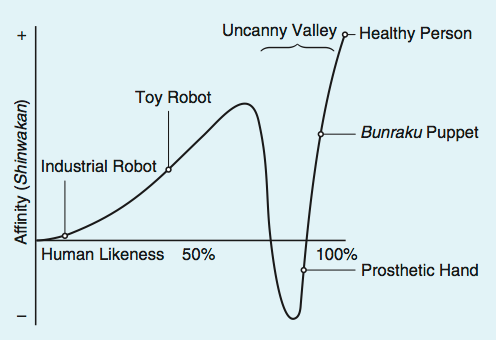
The Uncanny Valley

Thoughts on The Uncanny Valley, by Masahiro Mori

Reading The Uncanny Valley provided context to a familiar concept. I found it interesting to read a bit further and learn about what Mori is doing now and what his thoughts are on some of the new technologies. For me, the Uncanny Valley discussion brings up a lot of questions that are not easily answered. What are the consequences when a war veteran plays ultra-real first person shooter video games? What does it mean when kids act abusively towards realistic dolls?

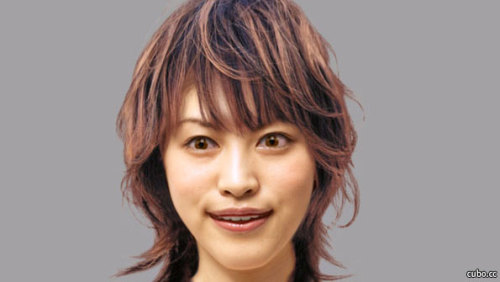
I agree with Mori, there is no reason to cross the valley; however, it seems like some designers and engineers are pushing hard to do so and some of their attempts are truly terrifying (see images).


the uncanny valley


Alone Together


Reflections on Alone Together, by Sherry Turkle

The idea of connection versus isolation resonates with me. In the design research class, my group is investigating what people do while they wait on the streets of San Francisco. Not surprisingly, the most common response is that people turn to their phone while waiting; they pass the minutes with texting, tweeting, facebooking, and instagramming. Initially our assumption was that this behavior is common because people want to be connected with one another. Turlke’s book, Alone Together, demands that we reevaluate our assumptions. Do social networks and SMS messages bring us closer together, or are they a substitution for an actual connection? I was not surprised to read about the college student who would rather text her roommate from the other room than knock on her door. Admittedly, I have “friends” with whom I have never spoken to on the phone; all of our communication has been through text, email, or Facebook. Even though I have known these friends for over two years, I avoid calling them up just to chat. A phone call to certain friends would be too intrusive, and maybe even too intimate.

One point Turkle brings up repeatedly is that robots represent risk free relationships. To illustrate her point Turkle introduces us to Neela, the eleven year old girl who comments that “Girls are two-faced...They can’t make up their mind.” (94) And Howard, the high school student who believes a robot would provide him with more accurate advice that his father does therefore preventing disastrous interactions with girls (51). Risk can make us vulnerable, uncomfortable, and scared, but when we take risks and succeed we build trust in ourselves and in our relationships. The idea that technology is allowing us to be increasingly risk adverse causes me to worry about my own communication patterns; however, the biggest question is, what happens when a person grows up without needing to take risks?

10/03/2012

Mind Map

My first section of design writing was with Laurie Seidler and was focused on maps. For the final project of the section I created a map of my neurosis and worries and wrote out a legend. Here's a sample.


When you flush a toilet, the force of the flushing water is enough to send particles flying up to eight feet in the air. I read this fact in a Kids Discover magazine in 1998 and it permanently changed my perception of and interaction with germs. For one, I can no longer see a toilet without mentally overlaying a sphere with a radius of eight feet and it’s center resting in the toilet’s bowl. This is the sphere of toilet particle contamination. The concept of the eight-foot particle launch is so deeply embedded into my brain that nothing could dislodge it; flushing with the lid up will always cause skin crawling discomfort no matter how many times the fact is disproved. In my current apartment, the bathroom is so small that the toilet sphere encloses three of the four walls. This is why I never leave my toothbrush sitting, exposed, on the bathroom counter top and why I do not keep my towel hanging on the towel rack. Because even though I never flush with the lid up, you cannot trust the guests.